





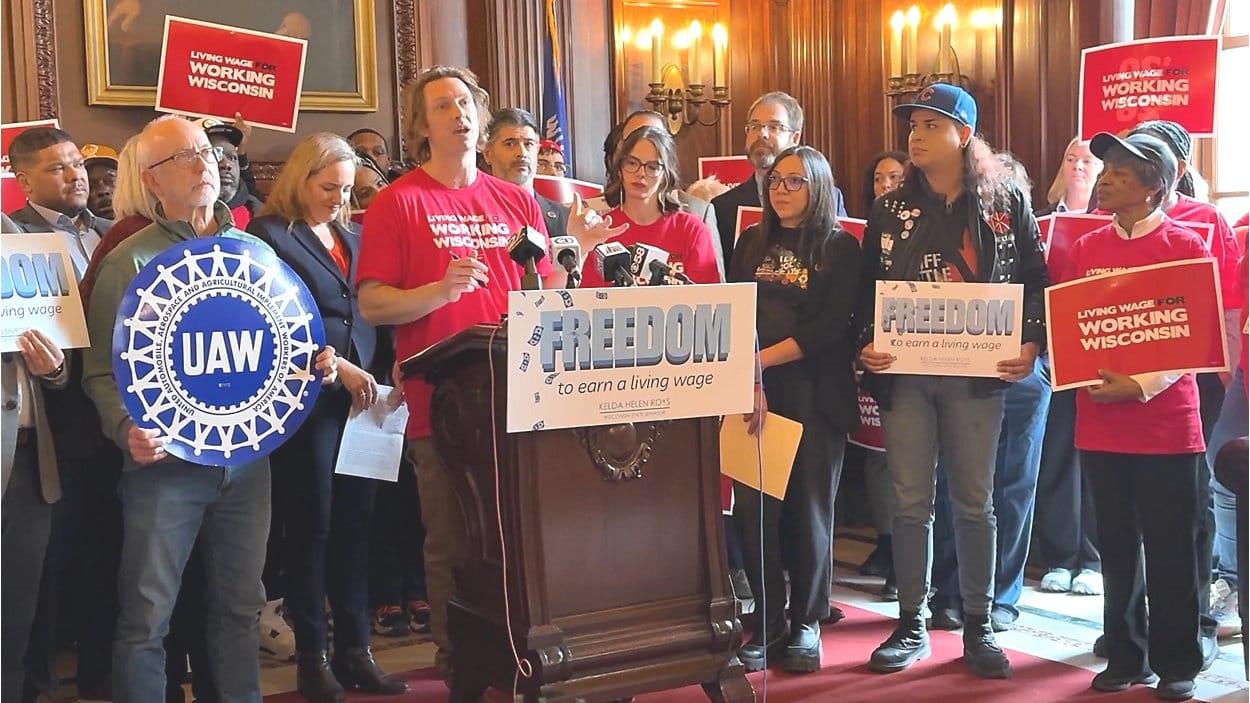


Wisconsin’s hourly minimum wage has been stuck on $7.25 for 17 years.
Democrats think that’s long enough.
State Senator Kelda Roys (D-Madison) and Representative Angelina Cruz (D-Racine) have proposed legislation that would more than double that to $15 an hour, with plans to reach a living wage of $20 per hour by 2030.
Nearly a million Wisconsin workers earn less than $20 an hour.
“We’re here because nobody working 40 hours a week should be living in poverty, struggling to put food on the table,” said Roys, who was in the legislature when that $7.25 rate was set. “Wisconsinites believe that an honest day’s work deserves an honest day’s pay. Everyone deserves the freedom to thrive.”
Cruz said the legislation would raise the wage to $15 per hour upon enactment, then increase it in stages to $20 per hour by 2030. Starting in 2030, it would be indexed to inflation. For small businesses with 50 or fewer employees, the $20 wage would be phased in by 2035.
The bill would also raise the subminimum wage for tipped workers – currently set at $2.33 – to $7.50 immediately, then phase it up to $10 by 2030.
In addition, the bill would repeal a Wisconsin law that bars local municipalities from enacting local minimum wage ordinances.
Tony Brewer, the lead chef at Fiserv Forum and chief union steward, expressed frustration with the lack of political support from policymakers. He also stressed the importance of his union, which helped raise his pay to the living wage it is today.
“Now I’m making more than $30 an hour,” Brewer said. “Nothing about my job has changed. Nothing about my work has changed. Just the fact that my coworkers and I have power from joining and organizing a union. Making work pay means making sure that workers have power.

“I (am) baffled and perturbed that so many of you (elected politicians) have done nothing about the most basic aspect of our lives,” he added. “Working to make a living by sitting behind your desk in the state capitol building with soft hands and doing nothing is mind-blowing to me.”
Peter Rickman, President of the Milwaukee Area Service and Hospitality Workers Union, spoke on behalf of the Living Wage Coalition, which includes the Milwaukee Area Service and Hospitality Workers (MASH), Working Families Party, Citizen Action of Wisconsin, Our Wisconsin Revolution, and Fighting Oligarchy.
“It is a very simple story,” said Rickman. “Forty years of building and expanding the middle class with unions and a minimum wage that put everyone above living wages. Then forty years where we’ve destroyed the middle class and seen Wall Street and one-percent types take everything that our economy has built with the hands of our labor. So it’s a simple choice that politicians have here.”
Roys said that while Republicans have left the capitol to campaign for re-election, Democrats will be in Madison, working to get this legislation done.
“Tonight, we’re making a different choice,” said Roys, who is a candidate for governor. “We’re going to continue working for this bill. But even if it doesn’t pass this session, we know that elected officials will be held accountable this fall, and when we talk about this, maybe this is the last bill of 2026, and maybe it’s the first law of 2027.”